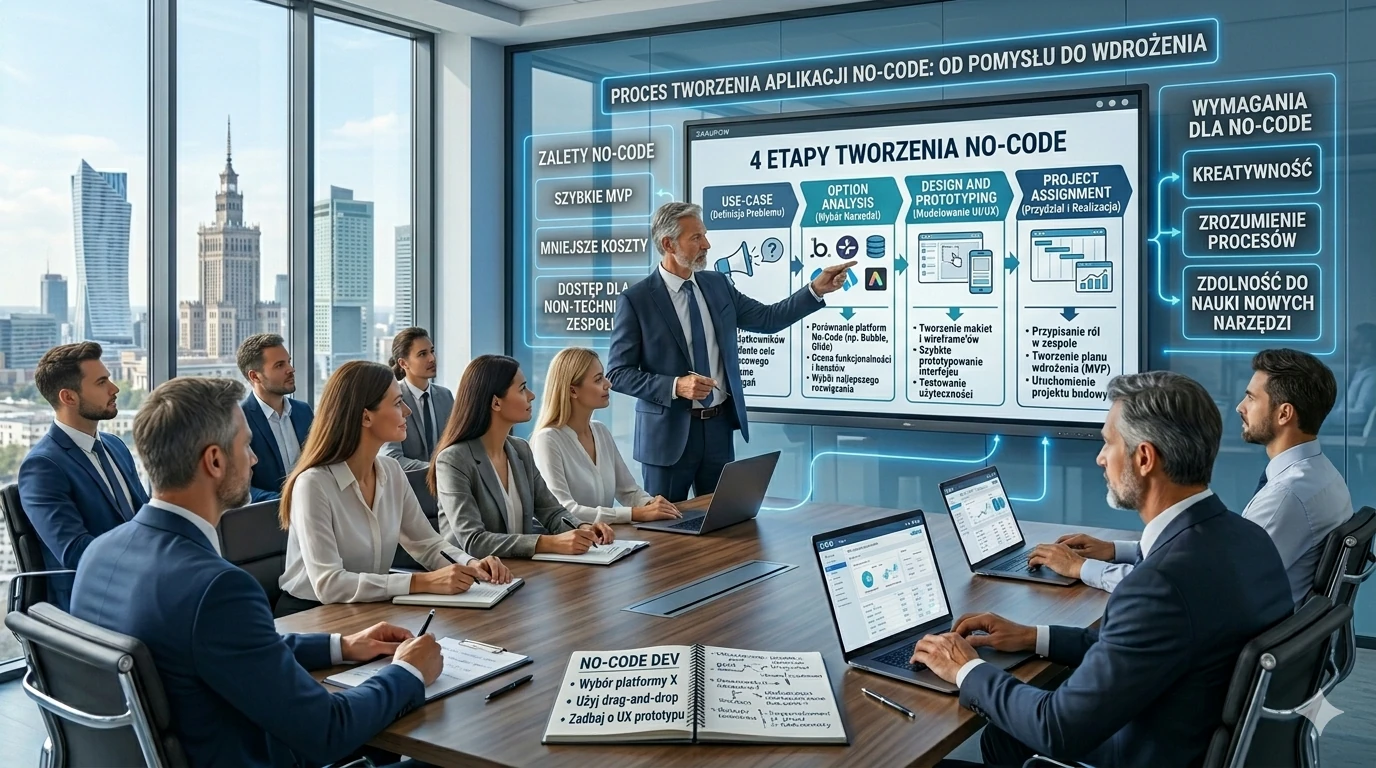
Evolution of No-Code: From Prototyping to MVP
From prototype to off-the-shelf MVP in a no-code environment, it's a journey that requires discipline in scope management, clever integrations, and end-user focused testing. Learn how to build functional apps without writing code, step by step: from interface and business logic, to analytics and Kanban, to effective change management.

Focusing on the practical aspect of developing no-code platforms, this article will look at the process of evolution from prototyping to MVP (Minimal Viable Product). We will trace the steps the team takes from UI development to integrations, testing and scope management, highlighting the importance of getting your product to market quickly in a dynamic business environment.
UX/UI: Building a No-Code Interface
In software development, the prototype is the foundation of the user interface. To ensure full functionality, teams add additional features or micro-use cases, expanding the prototype. This involves more complexity because you have to create new forms or screens. At the same time, teams take care of the convenience of use, facilitating navigation through the application, such as combining stages or automating the filling of fields.
In addition, new business rules and validation logic are introduced, necessary to create an MVP version. Finally, the appearance and user experience are adjusted to the general standards of the company.
Workflows and Business Logic: A Step into Complicated Aspects
Developing business processes from a prototype is a stage that requires diligence. At this point, details of the sub-processes and tasks are added, taking into account complex aspects such as the variety of situations and process variants proposed by the different departments or business units. It is also important to respond effectively to failures or process exceptions.
Integrations: Making Real Connections
In the prototyping phase, we often skip internal systems that will need to communicate with the no-code application to simplify the process. However, in the development phase, these integrations become essential. If these systems have predefined connections or modern APIs, we can configure them without programming. However, it should be borne in mind that sometimes it is necessary to work with developers as part of the IT team.
Charts and Analytics: Analyzing Business Performance
For better presentation and understanding of prototype results, charts and reports should be supplemented with real-world data and key elements of business use case analysis. The preparation of dedicated dashboards is important for gaining acceptance of the application, especially by the management team.
Kanban Progress Tracking: Flexibility in Project Management
Kanban is an effective way to manage no-code development because it allows you to flexibly adapt to changing needs and priorities. It also requires no specialized skills or roles, making it easy for business teams to implement. This is especially useful in situations where there are already specific processes and systems that need to be improved or integrated.
Software Development Cycles: A Model Connecting Technologies
We draw your attention to the fact that an important element is the comprehensive use of no-code solutions, which improve performance and reduce maintenance costs. Custom development should only be considered in situations where specific requirements arise that require a model combining different technologies. It is a good idea to involve software engineers in smaller projects, integrating them into a no-code team and using the Kanban method. In larger projects, developers can use proven methods, such as Scrum, before integration with a no-code application is possible.
Scope and Change Management: A Discipline in No-Code Development
To successfully prepare an MVP, discipline must be maintained regarding the scope of the project and change management procedures. New proposals for changes to functions should be clearly defined and monitored from the moment they are submitted. You should carefully consider whether they should be included in the MVP.
Timeliness, value for business and clarity of the use scenario are important decision criteria. Limited time to implement a product, focus on the most important features, and well-defined requirements are essential for success in creating an MVP.
Testing Software Without Code: Focus on End Scenarios
In the case of no-code development, software testing takes a different form. Instead of testing individual pieces of code, the focus is on testing functionality and end-user experience. Unit tests, which are often used in traditional development, are not usually necessary.
In summary, a key success factor in today's dynamic business world is to focus on quickly creating and deploying an MVP product. The ability to adapt to business needs and market changes is extremely important. The “no-code” approach is becoming an indispensable tool to help achieve this goal. Adopting this approach allows companies to meet today's business challenges while remaining flexible and innovative.